By Apronstrings Pet SittingPublished
Veterinary-informed pet care guidance led by founder Kim Tank, a former registered veterinary technician.
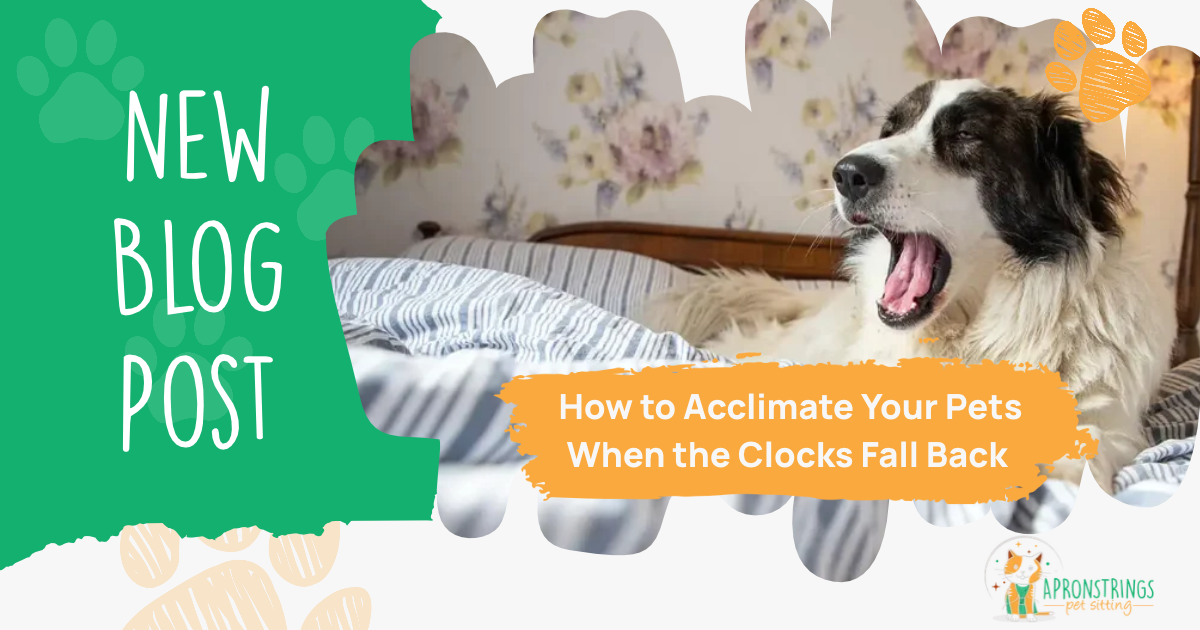
If you've ever had a pet stare you down at 4:45 instead of 5:00, demanding dinner like you've personally wronged them, you already know…our pets do not care what the clock says. They run on routine, light, and hunger, and we are always talking about how important a pet's routine is to them. During this time, it couldn't be more true.
When clocks fall back on Sunday, November 1st, here in Central Contra Costa County, we're not just losing an hour of evening light; we're asking our pets to quietly roll with a schedule shift they never agreed to.
Right now, sunset in Walnut Creek and the surrounding area is sitting around 5:09 p.m. By the end of November, it'll be dark before 4:50 p.m.
For pets, that shift shows up in a few predictable ways:
- Dinner-time demands getting earlier.
- Restlessness in dogs when a walk "should" be happening, but the window feels different, confused stares, pent-up energy, maybe a little extra whining by the door.
- More hesitation about that after-work dog walk once it's fully dark by 5:30.
And here's the twist...
Central Contra Costa isn't flat. A lot of our favorite walking routes, from the foothill trails near Walnut Creek and Lafayette to the quieter stretches around Pleasant Hill and Martinez, get dim fast once the sun dips behind the hills, often before the official sunset time on paper. Add in coyotes and other wildlife that get more active at dusk in those foothill areas, and an evening dog walk that felt easy in September can feel like a different decision entirely by mid-November.
Indoor cats feel the shift too, just differently. Less daylight coming through the windows in the afternoon can throw off their natural rhythm, and a lot of cats get noticeably more insistent around "dinner time" as the days get shorter.
Some Tips on How to Help Your Pets Adjust
- Shift gradually, not all at once. If you can, nudge mealtimes and walks by 10–15 minutes a day in the days around the change instead of flipping the schedule overnight.
- Keep the order of operations the same, even if the clock time moves. Pets key off sequence (Mom and Dad eat dinner, I get my dinner, then we do our walk and I wind down) more than they key off exact times.
- Add a little extra patience during the first week of November. A clingy pet or one that's slightly off-schedule isn't being dramatic; they're recalibrating.
- Consider hiring a dog walker for midday walks, so your dog still gets their exercise and routine without anyone racing the sunset, and you're not stuck choosing between a rushed evening walk and skipping it altogether.
- Or, if your dog already gets a 30-minute walk every day when you're in the office, perhaps bump that up to a 45-minute visit so they get more walk time in during the afternoons.
Final Thoughts:
At the end of the day, this is what we're here for. We obsess over the small stuff, the exact walk timeframe, the feeding routines, the little quirks that make your pet your pet, because we know it adds up to a pet who feels settled no matter what the clock says.
Does your pet get a little weird during the time change? Stare you down for dinner an hour early, pace by the door at the "wrong" time, demand extra cuddles because the house feels different? We'd love to hear about it!